
Fall foliage and when leaves change color
Fall color develops over several weeks rather than arriving on a single day. Shortening daylight begins the process, and elevation, latitude, tree species and weather decide when a particular slope changes and how long the color holds. This page covers when foliage season generally starts, what determines the timing, how a season progresses, and what to expect in each of the 50 states.
When does fall foliage start?
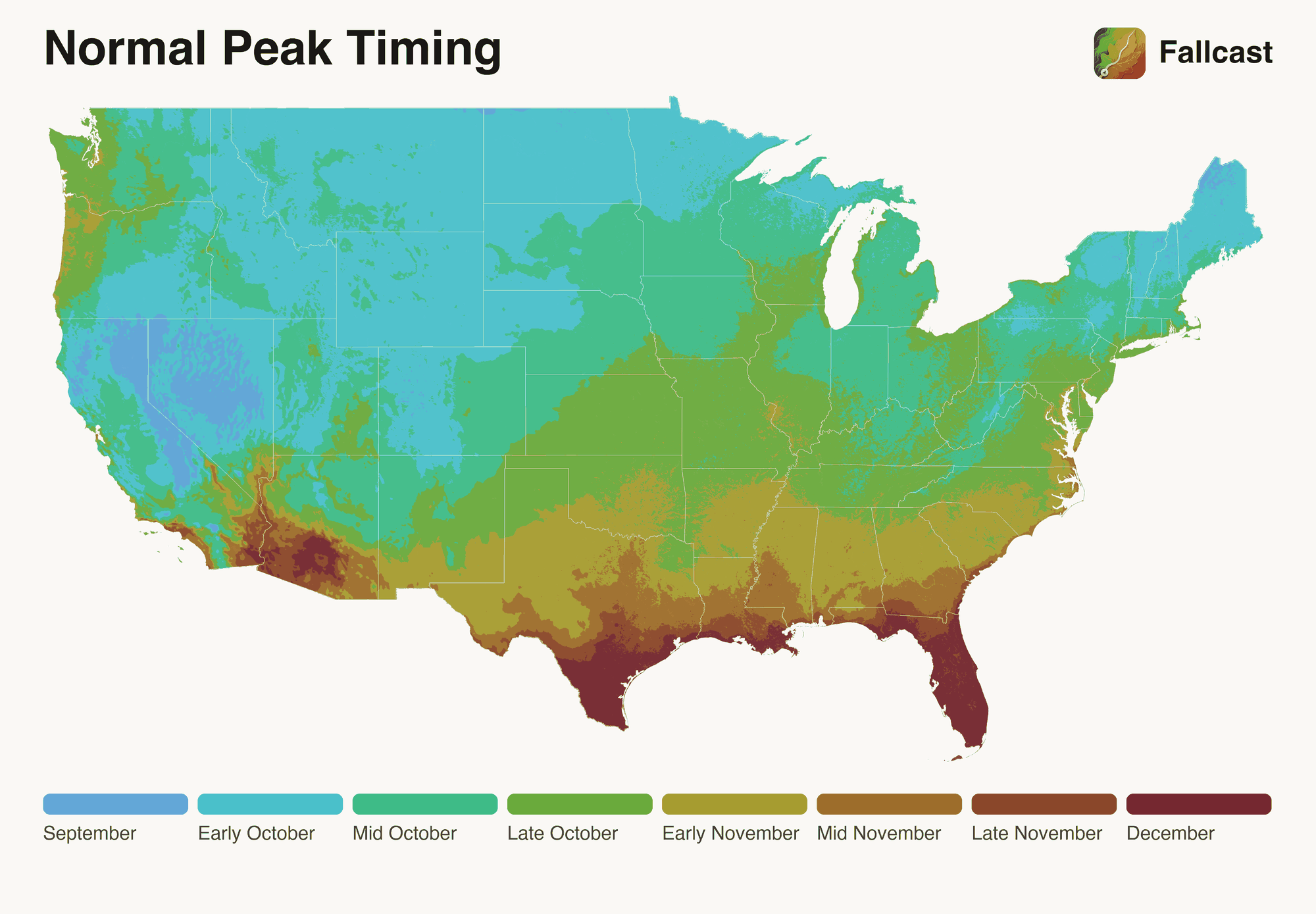
Fall foliage generally begins in late September in the northern states and at higher elevations, then moves south and downslope through October and into November. Northern Maine, northern Minnesota, Michigan’s Upper Peninsula and the high country of the Rockies and the northern Appalachians are usually the first areas to change. Most of the Northeast, the Great Lakes and the central Appalachians reach their strongest color during October. The southern states and the coastal plain are last, and color in the Deep South often holds into November. Alaska is earlier than any of them: its tundra and birch change from late August through the first half of September.
Timing varies considerably from one location to the next. In mountainous states a ridge and the valley below it can peak weeks apart even when they are only a few miles apart, so a single date for a whole state means little there. In flatter states there is less to separate one place from another, and the season tends to move as a gradual north-to-south progression over two to three weeks.
What determines the timing
Daylight
Shortening days start the process. As nights lengthen, a tree stops producing chlorophyll and begins closing off the leaf at the stem. The green fades, and the yellows and oranges already present in the leaf become visible. Day length repeats almost exactly from one year to the next, so a given place tends to change at close to the same time each fall, and the year-to-year variation is usually measured in days rather than weeks.
Elevation
Within a single state, a summit and the valley below it can be three or four weeks apart. In New Mexico, aspen high on the Sangre de Cristos change while the cottonwoods along the Rio Grande are still green, and the two are about an hour apart by road. Higher ground generally changes first and sheltered low ground last. In mountainous country, elevation usually accounts for more of the difference in timing than latitude does.
Latitude
Northern areas generally change before southern ones, and across a long state the gap is substantial. Michigan’s Keweenaw Peninsula is typically finished while the southern counties are only starting, and Georgia’s highest ridges change about a month before its coastal plain. Where a state has little relief, latitude accounts for most of the difference in timing, and the change moves gradually from north to south.
Tree species
Species set both the colors available and the order they appear in. Sugar maple produces orange and scarlet; aspen and birch turn gold; oaks and hickories turn bronze and russet and hold their leaves longer. A few deciduous conifers, among them western larch, tamarack and bald cypress, turn gold or rust before dropping their needles. Species also change at different times: black gum and sourwood redden early, maples follow, and oaks are often several weeks behind the trees around them. A slope of mixed hardwoods therefore colors over a longer period than a stand of a single species, and a pure aspen grove can go from green to bare in about ten days.
What changes the quality of the color
Weather affects how strong the color is more than when it appears. Warm sunny days followed by cool nights favor the red pigments, so those years tend to look more vivid; warm nights work against them. A dry summer can mute the display and shorten it, and a hard freeze or a windstorm can strip a slope in a day. Weather can move the timing as well, though usually by days rather than weeks. Most of the difference people notice between one fall and the next is in how strong the color is and how long it lasts, rather than in when it arrives.
How a fall season progresses
Color does not arrive on one day. A few trees turn first, usually the early species and the most exposed or drought-stressed individuals, and more of the canopy follows over the next week or two. Peak is the period when the largest share of leaves have changed and most are still on the tree. After that the display declines as leaves brown and fall, though oaks and beeches commonly hold their color and their leaves well into November.
How long any of it lasts depends on the mix of trees and on the weather. A slope of mixed hardwoods may show good color for two or three weeks, while a stand of a single species can be over in about ten days, and a hard freeze or a heavy wind can end it sooner. Peak in one place is also not peak everywhere: on the same afternoon a ridge can be past its best while the valley below it is still mostly green, and a north-facing slope is often ahead of a south-facing one nearby. That is why foliage reports usually describe a period of a week or more rather than a single date.
Fall color by state
Fall color progresses differently across the country. These state guides describe when and where foliage typically changes, how the season moves through each state, and which regions tend to have the strongest color. See all 50 states.
- New England. Connecticut, Maine, Massachusetts, New Hampshire, New York, Rhode Island, Vermont
- Mid-Atlantic. Delaware, Maryland, New Jersey, Pennsylvania, Virginia, West Virginia
- Appalachians & Southeast. Alabama, Arkansas, Florida, Georgia, Kentucky, Louisiana, Mississippi, North Carolina, South Carolina, Tennessee
- Great Lakes & Midwest. Illinois, Indiana, Iowa, Kansas, Michigan, Minnesota, Missouri, Nebraska, North Dakota, Ohio, Oklahoma, South Dakota, Wisconsin
- Rockies. Colorado, Idaho, Montana, Utah, Wyoming
- Southwest. Arizona, California, Nevada, New Mexico, Texas
- Pacific Northwest. Oregon, Washington
- Alaska and Hawaii. Alaska, Hawaii
What Fallcast is
Fallcast is a fall foliage forecast app for iPhone, arriving this fall. The pages on this site describe how a season usually behaves across a whole state. The app answers the narrower question of what is happening at one specific place this week, given as an expected period of color with a confidence attached and updated through the season as the trees change. It covers the whole of the lower 48, not only the well-known destinations. There is no release date yet; this page will be updated when there is one.
Contact
Questions, or a place you would like covered? Write to us.